cara agar cepat hamil weigh loss: 2013

Kamis, 22 Agustus 2013

Dwell in the real.....


You are better off dwelling in the real rather than wasting time searching for the ideal.

 The actual quote is the mature lifter is better off dwelling in the real rather than wasting time searching for the ideal, taken from this post at Dave Draper's forum.   

I read that the other day and it has stuck in my mind.

Dwelling in the real

So much of the health and fitness world is about fleeing from who we are.  Sometimes this is hidden or reframed as achieving a goal, changing our appearance.  Often though it is a case of a deep unhappiness with who we are.

There comes a time when we need to stop that and simply dwell in the real, to adopt some reality about who we are, what we can aim for.   There is nothing wrong with seeking improvement but we need to be realistic.  At 45 I will never play professional football no matter how hard I train.   With my bone structure and metabolism I will never be a competitive bodybuilder or powerlifter.   With my VO2 max and endurance I will never run a 3 hour marathon.  Aiming for such things will be a recipe for failure and more than that discontent.

However....I can be a good enough runner and better than most people.  I can develop a good physique, appropriate to my structure;  I can be leaner than 90% of guys my age; I can exhibit endurance to jog or walk for 20 or 30 miles.

I can do things which are excellent for me and for my potential.  The model that I can aspire to is not some shredded physique which is probably built on drugs and through superior genetic.  It is not a sub 3 hour marathoner.  It is me.

I think the word that sums it up is "contentment".  Being happy with what you have and making the most of it.

Identity

This identity thing is also present I think in all of the mad diets.  It is when people start to identify themselves with a diet.

  • I am paleo
  • I am gluten free
  • I am primal
  • I am low carb
  • I am vegan
  • I am a clean eater
No you are not;  you are you.  If you are "paleo" grains erode your identity.  If you are low carb, that pasta dish will take away from who you are.  As vegan you cannot eat those eggs and still be who you are.

It is all rubbish.  You are not your diet....or your training (I am a Crossfitter, a runner, a HITer)


Minggu, 11 Agustus 2013

Michael Moore on walking

I am no particular fan of Michael Moore's films or politics, but this piece on walking that I came across the other day is very good.

Michael Moore on Walking

I like his approach that walking is about the experience, the liberty to walk.  It is about the act, not the result.  Process, not outcome.  Yes, there will be changes, but they are not the focus.

Sabtu, 10 Agustus 2013

Kamis, 01 Agustus 2013

you can't teach speed?

Someone tweeted me this study and I thought I'd share it here.

The point that they are promoting is that good sprinters are born that way.  Those who are elite do not achieve that through working hard and hitting the 10,000 hours of practice that seems to have been accepted as the key to achieving elite status.  Sure practice helps, but in reality the true elite are perhaps elite before they really start to practice?

I don't think this totally invalidates the idea of developing exceptional ability through practice, at least where that is based on skill.  However perhaps it emphasises that it is worth pickin your field of endeavour to focus on one for which you are ....... gifted.


Abstract:      Most scientists agree that expertise requires both innate talent and proper training. Nevertheless, the highly influential deliberate practice model (DPM) of expertise holds that either talent does not exist, or that its contribution to performance differences is negligible. It predicts that initial performance will be unrelated to achieving expertise and that a long period of deliberate practice — at least 10 years or 10,000 hours — is necessary and sufficient for achieving expertise. We tested these predictions in the domain of sprinting. Study 1 reviewed the biographies of 15 Olympic sprint champions. Study 2 reviewed the biographies of the 20 fastest male sprinters in U.S. history. In all documented cases, sprinters were exceptional prior to or coincident with their initiation of formal training. Furthermore, most reached world class status rapidly (Study 1 median = 3 years; Study 2 median = 7.5). Study 3 surveyed U.S. national collegiate championships qualifiers in sprints and throws. Sprinters recalled being faster as youths than did throwers, whereas throwers recalled greater strength and overhand throwing ability. Sprinters’ best performances in their first season of high school, generally the onset of formal training, were consistently faster than 95-99% of their peers. Collectively, these results falsify the DPM for sprinting. Because speed is foundational for many sports, they challenge the DPM generally.

Minggu, 28 Juli 2013

Wall Sit research

James Steele was good enough to point this out to me.

In the basic Hillfit routine the wall sit is a fundamental exercise.  This is an isometric squat held for time with your back supported by a wall.  I included the wall sit for a few reasons:

  • you do not need any equipment
  • it is scaleable - if you are weaker, hold an easier position for example do not adopt a 90 degree knee position, don't bend your legs as far
  • it is low skill - you don't need to learn a complex move.  Squats are actually pretty complex to perform properly.  I think a good squat pattern is important for health and mobility.
  • it is safe - it keeps you in safe positions for your structure and muscles. (Bill DeSimone calls it a congruent movement - you use your muscles in a way that they are strongest where the movement is hardest)
I also find it an effective move for the thighs and hips in terms of producing strength.  Holding a 2 minute wall sit takes some strength.  I've talked about the exercise on this blog before by the way.

Anyway, James pointed out this paper, just published.


The isometric wall squat could be utilised in home-based training aimed at reducing resting blood pressure, but first its suitability must be established. The aim of this study was to determine a method of adjusting wall squat intensity and explore the cardiovascular responses. Twenty-three participants performed one 2 minute wall squat on 15 separate occasions. During the first ten visits, ten different knee joint angles were randomly completed from 135° to 90° in 5° increments; five random angles were repeated in subsequent visits. Heart rate and blood pressure (systolic, diastolic and mean arterial pressure) were measured. The heart rate and blood pressure parameters produced significant inverse relationships with joint angle (r at least –0.80; P < 0.05), demonstrating that wall squat intensity can be adjusted by manipulating knee joint angle. Furthermore, the wall squat elicited similar cardiovascular responses to other isometric exercise modes that have reduced resting blood pressure (135° heart rate: 76 ± 10 beats ∙ min−1; systolic: 134 ± 14 mmHg; diastolic: 76 ± 6 mmHg and 90° heart rate: 119 ± 20 beats ∙ min−1; systolic: 196 ± 18 mmHg; diastolic: 112 ± 13 mmHg). The wall squat may have a useful role to play in isometric training aimed at reducing resting blood pressure.


Interesting to see this benefit of the exercise - reducing blood pressure.  Exercise is often promoted as a way of controlling blood pressure, but people usually take that as "cardio", thinking strength training will raise blood pressure.  Here the wall sit is shown to be able to benefit blood pressure.

Another nice point in the abstract (I've not read the whole paper) is the observation that  

wall squat intensity can be adjusted by manipulating knee joint angle. 

That is what I mean by it being a scaleable move.


Senin, 22 Juli 2013

Examine's Supplement Goals Reference Guide

This post is a short interview with Sol Orwell.  Sol is the mastermind behind the amazing resource that is Examine.com  He has just launched a new product, a Supplement Goals Reference Guide, so I took the opportunity to ask him about Examine and the new Guide.

Can you tell my readers something about your background in health and fitness?

My journey is a bit different than most :) I "retired" a while ago - my internet businesses ran themselves, and I wasn't interested in the rat race. I'd rather travel, walk with my dog, and so forth. 
So after traveling and moving for a few years, I came back to Toronto in 2009. Out of shape (way too much delicious ice cream in NYC and Argentina). As I started fixing up my physical body, I also started reading and learning as much as I could. Im a notorious notes-taker, and slowly and surely the pieces started to come together.

What were you trying to achieve with the Examine.com website?

A lot of the knowledge I learned was from various forums. Forums always have their idiots, but some have some really smart people. People who have doctorates, people who compete, etc. And I noticed a lot of smart information was basically lost over time - we could have a really interesting conversation, but then one month later, that thread was (for all intents and purposes), gone. 
I wanted to build Examine.com as a repository of said information. I'll be honest - I knew a lot, but compared to some of these guys, I was a five year old. I found a great partner in Kurtis, who was just finishing up his dietetics degree. So he got to focus on the research, and I took care of everything else.
What does The Supplement-Goals Reference Guide add to the great information at Examine.com?
    The site is more geared towards the supplement->health goal relationship. It goes into pharmacology, interactions, etc. Basically, it's nerd heaven. I will eat a hat if anyone can find a page that goes more in-depth on supplements like fish oil, creatine, vitamin D, vitamin K, and so forth. 
    The reference is meant for two purposes: 
    1. Fast access. Open up the PDF, "search", and done. You instantly have the most pertinent info right in front of you - in vivo trials (animal and in-vitro studies excluded). 
    2. The opposite view: health goals->supplements. We are mostly anti-supplements in a bandaid fashion (eg if you eat fatty fish a few times a week, drop the fish oil). But targeted supplementation is brilliant. Berberine for diabetics. Spirulina for middle-aged people. Creatine for vegetarians. You can drill into your specific health goals (over 180), and find supplements that work (and even potentially supplements that can cause problems - eg someone with high blood pressure can find which supplements could increase his or her BP).

    Who is the Guide aimed at?
      People who take their health and fitness seriously. This includes coaches, naturopaths, teachers, nutritionists (all with clients), and also includes biohackers and quantified-selfers. People who appreciate their bodies and realize potential limitations (and potential areas to improve).

      Increasingly I have become disillusioned with a lot of the fitness information on the internet.  There are dodgy gurus out there promoting all sorts of secret knowledge to deliver muscle gain and fat loss.  Does the guide help to keep us on solid ground safe from the excesses of the marketing experts?
        You know it :-) We've been around for 2.5 years. We never recommend any brands nor any products. Our advisory board is not only chock full of pedantic people who take us to task for a misplaced word, but you can see on our testimonials that we have a host of MDs and PhDs who are willing to attach their name to what we do. And these are people from all over the fitness and health industry.
        The Guide
        Could the Guide save me money through stopping me buying useless pills?
          100%. Trib (for testosterone-boosting). Glutamine (for muscle building). Glucosamine for joint health? Black cohosh for monopausal symptoms? I could go on and on.

          Is there anything else you would want to tell the readers?

            We personally believe supplements are both over-rated and under-rated. As I broached before, one should not take supplements willy-nilly because it may have some undefined health benefits. Find out what your health goals, look up which supplements impact those goals (both positively and negatively), and supplement accordingly. Your health *and* your wallet will thank you.
            Thanks for that Sol!

            Examine.com is a superb resource which I would recommend to anyone with an interest in health and diet.  The Guide is adding something new and impressive to their toolkit.


            Senin, 15 Juli 2013

            A "does he even lift" jump

            What I like about this video is that the guy does not look like your typical uberlean fitness model.  He is an O lifter and a great athlete however.

            Rabu, 10 Juli 2013

            Searching for validation

            No magic bullet

            One of the themes that I've come back to a few times in recent months is the fundamental that there is no "magic bullet" when it comes to training.  So often we are searching for the new method, the gnostic truth that, after all these years, will finally yield those long desired gains in muscle and losses of fat.  We are a desperate and gullible market.  Show us an abstract from a study, or an impressive transformation photo and we are yours...paypal dollars flow for whatever ebook or course you are selling.

            The truth of course is that there is no secret method.  Patience, consistency and simplicity are what counts.  Realistic expectations.  The fundamentals remain fundamental.  Train hard, progressively and consistently over a protracted period on some safe exercises and be satisfied with the results.  Lots of methods will work within that space.

            Tell me I am OK

            What I've noticed in myself a few times in relation to all this is how eagerly I seek validation of my ideas.  I will mull over my training, analyse and re-analyse an exercise or routine and come up with an approach that I think will work for me.  Then, however, I start to google.....I begin to try to find those out there that agree with my approach, my new idea.  If I find some to agree with me - then great.  If not then I am cast into a slough of despond and doubt.

            The basics

            Let's just be boring.  Stick to some basics for a while.  Forget what else is out there.  Put some blinkers on for a while.  Give it a chance.  Be realistic.  Stick at it long enough for it to make a difference.


            Selasa, 09 Juli 2013

            Seated Box Jump

            I haven't had a decent jump on here for a while

            Resistance training is not rocket science; simple is almost always best

            The title of this post is a simple quote straight from an article by Clarence Bass.  He is someone that I have referred to on this blog before, someone who has long been an inspiration and an education, since I first read his book Ripped in 1986.    He has informed my thoughts about training and diet as much as anyone has.

            This article says a lot about what i think about training.


            Minggu, 30 Juni 2013

            Getting up....

            I was visiting my Mum last weekend.  She is getting older.  Still well enough, although the trials of age are catching up with her.  Noticeably in terms of mobility, basic movements.

            It made me think of a comment that someone made on a recent post:


            I recently got a daily e-mail from John Wood, of bodyweightbasics.com. It is usually a little sales pitch for an old time strongman book or some cool equipment, but sometimes it's training tips, routines,etc. This days was about the get-up. Not the Turkish get up, just the get up. Lay on the floor, front or back, and stand up. Do this 50 times. Try to make each one a little different. Alternate laying on your back and front. He uses it as a finisher on his workouts. I am terribly out of shape, and I tried it. It did give me a workout. Given what you have noted the importance of being able simply rise from the floor can mean, especially in old age, I am not sure I can think of a more simple, basic and safe exercise that may provide more benefit. Just thought I might share, and who knows, if you revise Hillfitt again, maybe add it to your list of exercises. 

            There is something to this, the idea of floor living that I've mentioned before.  You don't need to be doing 50 reps of this, just being capable of getting up from the floor.

            In terms of functional training, this is what counts.  I am all for basic, accessible, simple and safe strength training to build muscle and strength.  You need to use that strength though in basic real life moves.  As you get older what will be important is not only the strength to be independent, but the preservation of the skills of independence:  sitting, standing, walking, getting up and lying down.

            Rabu, 26 Juni 2013

            Another plank world record

            I think I featured this guy in the past, but he has gone and broken his own world record for the plank with a stunning 3 hours, 7 minutes, and 15 seconds.


            The full story is here.

            Selasa, 11 Juni 2013

            An interview with John Sifferman

            John Sifferman has just posted an interview that he did with me focussed on the Hillfit book.  It is on his Physical Living site.

            The questions really let me get to the heart of what Hillfit is about


            Minggu, 02 Juni 2013

            Another win for brief intense exercise.

            One hard 4 minute session seems to have effects similar to 4 x 4minute sessions. The whole study is available and worth looking through:

            Low- and High-Volume of Intensive Endurance Training Significantly Improves Maximal Oxygen Uptake after 10-Weeks of Training in Healthy Men


            Conclusion
            Our study demonstrated that slightly overweight and healthy individuals only required brief, duration bouts of exercise with good effort three times a week, to produce large increases in VO2max and work economy and reduce blood pressure and fasting glucose levels. Additional studies to examine both adaptations at the molecular level and feasibility for public health appear warranted.

             There is a further write up here.

            Senin, 27 Mei 2013

            Running out of things to say

            This blog has been quiet.  I am finding that I am running out of things to say.  Rarely am I coming across a news story or piece of information that I think deserves to be shared here.

            My work is busy again which is draining my time and energy, so that when I get home I am not enthusiastically trawling the interweb for titbits of information.  I am resting or relaxing in other ways.

            But I am also changing in my outlook - less convinced of the alternative approaches and more open to the mainstream.  The internet is full of misinformation, crazy theories, cults and covens - not just in the worlds of politics and religion, but health and fitness.  I've watched amazingly nasty arguments arise among people intensely committed to certain diets or training protocols.  First world problems indeed!  Cherry picked studies, abstract fuelled bloggers conspiracy theorists.

            As such I don't want to add to the misinformation.

            I am still training, still walking in the mountains, but no longer searching for the holy grail in my training or diet.  Patience, persistence, moderation, realistic expectations.  They are not too glamorous, do not sell many ebooks, but in those qualities resides the truth.

            I am still training
            I am still here and will post when I find things of interest....but there is not too much that is grabbing me at the moment.  Most of it has been said and much of what I have said and posted in the past I might now want to distance myself from.  Lots of approaches work and the internet experts are not always genuine.  There is a real world out there.

            Selasa, 21 Mei 2013

            5 to 9 thinking

            This is not the normal fodder for this blog, but I like this guy and his attitude.  Read more from him here.

            Sabtu, 18 Mei 2013

            Muscle Ups

            For a big guy he does some impressive muscle ups:


            natty?

            Abstract thinking

            This is why I don't do many of the style of posts that I used to get up here - finding an "interesting" abstract, posting it and carrying on.  I have realised that without reading the paper you can be very misled.....  There is more than the abstract.

            Bryan Chung's Evidence Based Fitness blog from where I got that piece is a good resource by the way.

            Senin, 06 Mei 2013

            What the Internet is Doing to Our Brains

            I've read Nicholas Carr's book The Shallows.  It is superb and a little frightening in its implications.

            Sabtu, 04 Mei 2013

            The importance of strength training as you get older....

            via Save yourself.  This is vital stuff, well expressed.

            I could quibble over some of it in terms of form or whatever, but the message here is superb.


            Rabu, 01 Mei 2013

            Thinking hard and its effect on appetite

            This looks like an interesting study:

            Thinking hard makes you hungry.....so you eat more.  Yet thinking hard doesn't burn calories.  So if you are going to think hard then eat, well you better do something to burn the calories that you are going to add.


            Abstract
            WHAT IS ALREADY KNOWN ABOUT THIS SUBJECT:
            Achievement of a stressful mental task leads to increased energy intake over a short period of time. Given that mental work does not increase energy expenditure, a positive energy balance is observed.
            WHAT THIS STUDY ADDS:
            The single fact of waiting and relaxing after mental work does not reduce energy intake. Thirty minutes of physical activity performed at moderate/high intensity between mental work and a meal is enough to create a energy deficit compare to a situation where the meal directly follows mental work.
            BACKGROUND:
            Although energy expenditure during mental work is not higher than energy expenditure at rest, a stressful mental task is related to an increase in energy intake. It is suggested that mental work produces physiological changes, thereby influencing food intake.
            OBJECTIVE:
            Because physical activity can influence hunger, the aim of the study was to determine if the introduction of an active pause could counteract the negative effects of mental work on energy intake and energy balance.
            METHOD:
            Twelve male students, of normal weight, between 15 and 20 years old were evaluated. All subjects participated in three different sessions realized in a randomized order: (i) without pause = relaxation/mental work/meal; (ii) relaxation pause = mental work/relaxation/meal; and (iii) exercise pause = mental work/exercise/meal. Energy expenditure was measured with indirect calorimetry, energy intake was measured with a cold buffet-type meal of 40 items, and appetite-related sensations were measured with visual analogue scales. The effect of introducing an active pause in energy intake and energy balance was studied.
            RESULTS:
            The introduction of an active pause did not influence energy intake; although, higher appetite-related sensations were observed (16-26 mm on a 150-mm scale; P < 0.05). After accounting for the energy expenditure related to physical activity, a lower energy balance was measured for the exercise pause visit compared with the visit without a pause (-1137 kJ; P < 0.05).
            CONCLUSION:
            This study indicates that being active between mental work and a meal could represent a strategy to create a negative energy balance following mental work via an increased energy expenditure and a maintenance of energy intake. Globally, these results could help individuals attain and/or maintain a healthy body weight in a context where mental work is omnipresent.

            Kamis, 25 April 2013

            Broccoli Bread

            I'm not quite convinced that bread should involve broccoli....but still this looks interesting and tasty.  I've made a few of Anna's recipes - her recipe book is fantastic - and I will make this I am sure.


            Check out the whole post.

            Rabu, 24 April 2013

            Hillfit v 2.0

            I've finally updated Hillfit - the ebook that I released about 16 months ago.  The idea behind Hillfit is that the average person who enjoys hiking, hillwalking and time in the outdoors can have more fun, find every walk easier, be safer and more resilient by getting a bit stronger.

            Getting Stronger

            Getting stronger shouldn't be a complex matter - picking some simple and safe exercises and doing them consistently can make a huge difference.

            The focus of it all is enjoyment  -  I want you to have more fun in the hills - getting stronger lets you do that.

            What is new

            Version 2.0 is a lot more than an update.  It contains about 70 additional pages, more material and contributions from several other trainers and exercise scientists.  The structure is:


            • PART 1 WHY GET STRONGER
            • PART 2: HOW TO GET STRONGER
            • PART 3: APPLYING YOUR STRENGTH TO THE SKILL OF WALKING
            • PART 4: BEYOND STRENGTH
            • PART 5: PUTTING IT ALL TOGETHER


            Contributors

            This time, it is not just me...there are contributions from 

            • Tim Anderson - who writes about the mental and physical benefits of hiking in the countryside
            • James Steele II - explains how there is no such thing as cardio - proper strength training has a range of metabolic, cardiovascular and cellular impacts that are normally only associated with endurance training
            • Skyler Tanner - notes how walking  is different from exercise
            • Bill DeSimone - describes how to choose safe exercises 
            • Steven Sashen - looks at how to walk efficiently
            • Todd Hargrove - outlines some exercises to improve mobility, balance and proprioception
            • Colin Gordon - writes about  mobility and some daily exercises to keep you supple.


            Buy it here

            The book is for sale via www.hillfit.com  or you can just click here:

            Buy Now


            The price is now £10.

            Questions

            If you have any questions, please get in touch.


            Selasa, 23 April 2013

            The Human Effect Matrix

            The guys behind Examine.com have just released a great new resource:  a "Human Effect Matrix."
            For every supplement in their database, a handy table tells you what effect each supplement has and how noticeable that effect is.

            To see what we are talking about, click through to see what the scientific studies say about:

            Selasa, 16 April 2013

            PULLING SOME THREADS TOGETHER: SITTING, POSTURE AND GRAVITY


            I CALL ON YOU TO FIGHT GRAVITY

            This might be a bit of a disjointed post but I wanted to pull together a few ideas that I’ve been thinking about recently, prompted by a few things that I’ve read some of which I’ve mentioned here.    It is just a case of getting some ideas out of my head, so please do not be too hard on me for a long rambling post.


            Over the life of this blog I have looked a few times at posture and neuroplasticity – the idea of how the brain itself can change and modify itself in response to what you do with it and with your body.  I’ve also often pointed to the reports of the dangers of a sedentary life.  Without necessarily spinning some grand theory I wanted to highlight a few ideas and maybe begin to plot some connections.

            MUSCLES THAT TIGHTEN, MUSCLES THAT GET LOOSE

            This is an idea that I think I first came across from Mark Reifkind, then Paul Check and then Dan John.  I think Chek got it from Janda.  They talk of tonic and phasic muscles.   Certain muscles tend to get tighter with age, injury, under-use or over-use.  These need to be stretched.  Others tend to get weaker and they need to be strengthened.

            Which ones are which?

            MUSCLES THAT   GET   TIGHTER WITH AGE

            Stretch them
            MUSCLES THAT GET WEAKER WITH     
            AGE
            Strengthen them
            Upper Trapezius
            Pectoralis Major (Chest)
            Biceps
            Pectoralis Minor (deep chest muscle)
            Psoas (hip flexors)
            Piriformis
            Hamstrings
            Calf Muscles
            Rhomboids
            Mid-­‐back
            Triceps
            Gluteus Maximus
            Deep Abs
            External Obliques
            Deltoids

            A simple way to picture all this is of flexors and extensors.  The flexors – the muscles that bend, that pull bones together – get tighter.  All of those muscles in the left hand column: when they get tight, flexed, you end up in a tight ball.  Legs bent, toes pointed, knees to chest, arms bent, shoulders hunched up and chest collapsed.  You go foetal.  The extensors are the opposite.  These are the muscles take you from the foetal to the upright.  When these are tight you are erect, arms and legs straight, shoulders back.


            When we think of an old person, we picture then with the flexors tight – they are bent over, stooped, arms and legs bent.  The youthful person is different – they are erect, the extensors are working well. 

            We have a battle between flexion and extension.  Between the foetal position, which becomes the posture of old age, and the erect posture of the child and the athlete.

            Incidentally, notice also how the foetal position is the position we adopt in fear, in response to a threat.  The brave, resistant fearless position is the opposite.

            It is also interesting that the muscles we need to strengthen are often those that we ignore or find boring.  We need to be rowing, pressing, hingeing and squatting rather than curling and bench pressing.

            GRAVITY AND THE BATTLE

            What makes this battle?  Gravity. 

            This is where I come back to the ideas of Philip Beech and his erectorise exercises.  It is also connected to the writings of Dr. Joan Vernikos, who notes that sitting and the sedentary life is actually a life in which people minimise the effect of gravity.  She compares the impact of weightlessness on astronauts and each of the negative health impacts that are observed in them are evident to a lesser scale in those who spend a lot of time seated.

            We tend to forget about gravity.  It is always there!  Forget about exercises, liftin weights or even lifting your bodyweight.  Our bodies are under a constant pressure from gravity.  Gravity is always trying to bend us over, push us down and return us to the foetal position from which we started.  It never stops.  To stand up, erect with legs straight, shoulders back and head up requires work, effort against gravity.  It requires the extensors to work……all the time.  Unless you keep working these muscles  BY SIMPLY STANDING AND BEING ERECT they will get weaker, they will get looser.  Gravity wins! 

            The other muscles?  As you stop fighting gravity and you collapse – ultimately into a ball….or a chair – those flexors settle at a shorter length.  If you never stand up straight into extension, your hip flexors will never be lengthened.  Your hips will always be bent.  You will collapse in on your self.  You become old, flexed. Weak.

            WE ARE IN A FIGHT WITH GRAVITY

            As a child develops from back, to roll, to crawl, to sit, to stand, to walk, gravity is slowly battled and mastered.  The force that held the baby down is finally overcome until he is able to stand, the muscles keeping the body erect.  


            We become what we were meant to be – a biped.  Upright and erect in command of our bodies.  And as such with healthy brains, plastic brains that develop the connections and the maps to govern that movement.  As we stand and move all of us gets healthy, even our brains.

            But as we abandon the physicality of life, sit down and succumb to gravity that is lost.  All sorts of systems in the body suffer including the brain.

            RECOGNISE THE FIGHT

            We live in a world of gravity, but we don’t notice it.  Apart from all exercise and training, concerns about exercise form or protocol, first of all respect the basic truth that we live in a world of gravity.  This force is trying to pull you down – literally and metaphorically.  Health and simply being human depends on mastering gravity.  Stand up for yourself!  Stand against the world.  Think of all the phrases that signify strength and robustness – the things that you stand for, the things that you stand against.  Sitting down, sitting it out – you collapse, gravity wins.  Standing up – you assert yourself.

            I don’t know where I’ve got with all this!


            TAKE A STAND

            Anyway if nothing else….start to think of standing as an heroic battle against gravity.  Keep up the fight as long and as effectively as you can.  Sitting, slouching, poor posture is giving up that fight.  Going foetal reeks of fear.  Getting erect speaks of character, fight and bravery.  (I've also noted on the blog before how posture affects attitude - if you want to be confident then take a confident posture)

            Senin, 15 April 2013

            Andrew Marr's stroke - HIIT?

            I just thought I'd point to this - Is exercise to blame for Andrew Marr's stroke?  

            Marr is a fairly high profile journalist / TV presenter in the UK.  He suffered a stroke a few months ago that he is now blaming on interval training on the Concept 2.


            Marr said he had followed the advice to "take very intensive exercise in short bursts – and that's the way to health … I went on a rowing machine and gave it everything I had, and had a strange feeling afterwards – a blinding headache, and flashes of light – served out the family meal, went to bed, [then] woke up the next morning lying on the floor unable to move". 

            As usual, the NHS piece is pretty balanced, although it is a little concerning the way in which the medics talk about the potential dangers of interval training:


            "Regular exercise is an important factor in stroke prevention and recovery. We have heard anecdotally that some activities like vigorous exercise can sometimes cause blood vessels to burst. We need more research on the underlying factors that might make that happen.
            "We do know that high blood pressure itself is the single biggest cause of stroke. Until more research is done on specific triggers, we'd suggest getting your blood pressure checked and taking steps to keep it under control – exercise can help with that."


            Maybe there was more to it though:


            Despite the media emphasis on the stroke risk exercise could pose, it should also be borne in mind that Andrew Marr has said that he had been "heavily overworked". Stress is a known risk factor for high blood pressure, and it is possible that this may have played a part in his condition.


            Minggu, 14 April 2013

            ....Feeling like a Heretic

            Just an excuse to play some Lloyd Cole:


            "Looking like a born again, living like a heretic"

            That was the phrase going through my head this weekend as I thought about this post.  The heresy?  For so long I've been identified with, and I suppose in some ways promoted, certain positions in terms of fitness and diet.  There has been a lot of other stuff on the blog: big jumps, neuroplasticity etc, but the recurrent themes are probably diet and exercise.  Diet: paleo-ish and fairly low carb.  Fitness:  HIT style weight training.  The thing is, over the last few months, maybe longer, I've moved away from both to some extent.

            Such shifts make me feel like a heretic....like I am rejecting some fundamental truths.  Not only a set of principles, but the people, the tribe.

            Looking like a born again

             The change has not harmed me.  I am leaner than I used to be when limiting carbs and have more muscle than I did while training once a week to failure.

            Giving up the search for the philosophers stone


            There is probably more to write about why I've moved on from low carb paleo, but essentially I drifted from low carb - I realised that carbs were not the enemy but often the preferred source of fuel.  Then overtime I started to question much of the dogma of paleo, particularly the quasi-religious nature of the whole paradigm, this utopia from which we fell in which we all lived these ideal lives, with optimal diets, social interaction and physical activity.

            In terms of exercise I am still walking, spending time in the hills.  I am doing balance work and trying the movement rests that Tim Anderson writes about in Becoming Bulletproof and Original Strength (very Feldenkrais influenced).  But weights has gone on to 3 or 4 days a week, with the old bodybuilding split of chest/shoulders/triceps & legs/back/biceps.  Focus on progression in weight, not going to failure.  One exercise "heavy" 3 sets of 4-8, then one exercise at 2 x12-15.  This is based on Brad Schoenfeld's paper on the mechanisms of hypertrophy (mechanical stress, metabolic stress and muscle damage) with the heavy move pushing the mechanical stress and the lighter set going for the metabolic stress.  A bit like Lyle's bulking routine.  I am not rejecting HIT, just talking a change for a while because I actually enjoy training more than once a week.

            Gnosticism

            The whole alternative, gnostic, hidden knowledge is so attractive.  We have something that the mainstream doesn't have.  It plays on the same fears and conceit that drives nutty conspiracy theories.

            The thing is that all this alternative stuff is not really needed.  The mainstream often has the truth, but we do not want to listen or apply it.

            The bodybuilders got it right

            Increasingly I am coming back to positions that I had 15 or 20 years ago.  Maybe longer.  The sciencey bodybuilders.  Clarence Bass, Alan Aragon, Lyle McDonald.  Newer writers too like Go Kaleo.

            We are searching for the truth about how to get lean, muscular and fit and the natural bodybuilders have been doing it for years. (Natural I said....drug assistance means lots more latitude).  Then build muscle and get lean....often without the craziness. (There is some craziness but there is also some sensible stuff)


            The internet led me astray?

            I discovered the internet in about 1996 and immediately started searching for fitness stuff.  I found low carb then paleo then Art Devany.....and then it was deep into the alternative realms.

            The basics stay the same

            I still think the basics are the same as I've been writing for a while:

            Eat real food
            Progressive strength training
            Stand up straight
            Get enough sleep.

            and of course, patience and consistency.

            I can't give up

            I will keep reading, writing, thinking and hopefully progressing.... of course I can't give up the search to  improve, to learn.


            Senin, 08 April 2013

            No such thing as Cardio


            James has contributed a chapter to the new version of Hillfit, which should be out in a couple of weeks,  in which he covers the things he goes through in this talk.

            Kamis, 04 April 2013

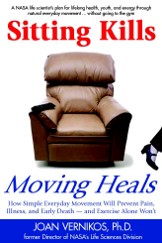
            Sitting Kills Moving Heals

            Just a quick shout out to point you towards this book, Sitting Kills, Moving Heals: How Simple Everyday Movement Will Prevent Pain, Illness, and Early Death -- and Exercise Alone Won't, Dr. Joan Vernikos.  


            There has been so much recently about the dangers of the sedentary life, but this book joins the dots in a very interesting way.  Vernikos was involved in Space projets at NASA and she points out how the impact of weightlessness in space are actually the same impacts - but amplified and condensed - that flow from spending so much time sitting down.

            Sitting is our way of avoiding the challenges, the exercise, that are properly delivered by gravity.

            Her prescription is expected - move more - but it is the language that is interesting and motivating - the idea of doing more Gravity Exercises.

            She points to some good research too.  For example it is not just about spending time stood up....but the repeating acts of standing that are important.  It reminds me of the floor exercises ideas that I pointed to a few weeks ago.

            Highly recommended.

            Logical Fallacies and more thoughts on paleo


            Consistency and habit

            I am sorry that this blog has been quiet recently, but I've just not been finding things to post: either items that I wanted to highlight here or things that I wanted to write.  I've been distracted by other things - like climbing hills in the sunshine and snow - but also I have been aware of the fact that sometimes there is not really much to say.  In recent posts I've pointed to the idea that consistency and habit, patience and persistence trump most things when it comes to fitness and health.  There is only so many times that you can say this before it gets boring.

            Logical Fallacies

            When I have been thinking about "fitness" issues I've actually been reflecting a lot on how limited my outlook has been for so long and how this might have been affecting my results.  A lifetime ago - or so it seems - I did a degree in Philosophy.  I did three years worth of formal logic, which was one of the parts of the course that I really enjoyed - the analysis, the equations into which arguments were broken down and expressed.

            Recently I've been thinking about logical fallacies - errors in reasoning, arguments that might look valid at first but which on deeper consideration are actually invalid:  the conclusion does not flow from the premises.  There are lots of lists of such fallacies but Your Logical Fallacy Is...  sets out a good few.

            For example:


            personal incredulity

            Because you found something difficult to understand, or are unaware of how it works, you made out like it's probably not true.


            or

            the idea of an argument from silence:  the absence of evidence is not the evidence or absence.....


            Your exercise routine / diet is based on an invalid argument

            Anyway, I suppose this gets me to some more thoughts on Paleo.  The Paleo backlash is now underway with videos like this:


            or Marlene Zuk's Paleofantasy (interviewed here)

            I actually think the best analysis was done - with a good sense of humour - by Matt Stone in

            12 Paleo Myths: Eat Better Than A Caveman 


            Reading that and thinking through the arguments a lot I came to realise that a lot of the dogma was just wrong.  In terms of the logical fallacies we were so often at:


            appeal to nature

            You argued that because something is 'natural' it is therefore valid, justified, inevitable, good or ideal.


            The whole grok thing, spinning an ideal of how we were intended to live.....it sounds good, it sounds romantic but either there is nothing to it or else it is just banal obvious statements.

            Common Sense

            I was trapped in a paradigm for a while there, seeing everything through the "primal" lens.  Now I am realising that I was being stupid to be so limited in outlook.


            Minggu, 31 Maret 2013

            People don't trust fat doctors

            This one raised a smile when I saw the abstract:


            Respondents reported more mistrust of physicians who are overweight or obese, were less inclined to follow their medical advice, and were more likely to change providers if the physician was perceived to be overweight or obese, compared to normal-weight physicians who elicited significantly more favorable reactions. These weight biases remained present regardless of participants’ own body weight.

            I suppose it makes sense.  Why follow their advice if they are unable to achieve something in their own bodies.

            How does this apply to other areas like fitness or diet gurus?  I think this is where it gets more complex.  I think a diet guru who is promoting a certain approach as leading to health or leanness should really be healthy and lean.  However in terms of fitness, the 6-pack is not always a sign that they know what they are doing.  Favourable genetics and chemical assistance can often deliver a decent physique despite the particular approach to training.  Looking good doesn't mean that you know what you are talking about.....but if you know what you are talking about you should at least look decent.

            Kamis, 28 Maret 2013

            Senin, 25 Maret 2013

            Tabata hits the showbiz big time

            So I was reading a standard journalists piece about the Tabata protocol - you know: "Get fit in 4 minutes!!!" and all that.  So far so good - this stuff keeps popping up every now and again as a journalist discovers interval training and decides to break it to the world.

            Anyway, what was different in this one was that they actually spoke to Tabata himself.  He stressed something that I mentioned in the Wingate post - you need to work very very hard:

            "....I often go on YouTube and, while I am honoured that people are doing it, some are doing it wrong because they don't realise the intensity you need to work at," says Tabata.

            Tabata is addressing this by staging his own PR campaign:

            It's slightly surprising, therefore, that the plan is still the preserve of the serious athlete and musclehead crowd – although that may change now that Tabata has agreed a deal with Universal Studios that will lead to a network of instructors and a DVD range released towards the end of the year. 

            So we are facing an official Tabata instructor and DVD programme.

            The story is at

            The Tabata workout programme: harder, faster, fitter, quicker?


            Oh well....here we go.

            Sabtu, 23 Maret 2013

            HIIT - Sprints on the bike

            me on Thursday...
            Walking to work the other day I listened to a podcast from Layne Norton - Muscle College Radio - where he was discussing cardio and particularly high intensity intervals.  There has been enough on this blog over years about interval training (e.g. here) and its benefits, but it was interesting to hear this discussion especially as they got into the different pathways in the muscle that were activated by different types of exercise.

            There has been a lot of research done on intervals in Dr Jake Wilson's lab where they seem to have a particular interest in bodybuilders looking to gain muscle and lose fat.

            Anyway in their experiments they tend to use what they describe as a Wingate bike - a stationary cycle set up for the Wingate test.  You pedal to reach a peak revs per minute and then a load is added to the bike to make it harder....then you go as hard as you can for 30 seconds.  This is not just pdalling hard....this is hitting a hard resistance that gets so hard you struggle to pedal.  Their intervals are not just a few sprints....they are all out to failure efforts.

            There is a video of the standard test here - you can see her hit a peak rpm and then the weight falls and she goes as hard as possible for 30 seconds basically just about failing at the end.


            Here is another which explains it a bit


            What is striking is that this is not your average sprint....this is tough to failure... hard work.  It may be that this sort of intensity is not strictly needed, but it does make you question just how hard you are actually working!

            The podcast gave an idea for how to do this on a normal stationary bike


            • warm up 
            • start to cycle going faster and faster
            • when you are at a max rpm, pump up the resistance level as high as possible 
            • keep going as long as you can until you fail
            It is not a perfect substitute but it works well enough.   I tried it yesterday for a series of sprints and it gave a massive leg pump.....


            Interesting how hard this is...and how similar - in the to failure aspect - to that other HIT.

            Also check out Clarence Bass new piece on intervals with weights

            Jumat, 22 Maret 2013

            Victorian Health

            I just wanted to point to this paper on the health, diet etc of the Victorians.  It is fascinating in itself and also in the context of all the discussions of paleo, ancestral health etc.

            The paper is


            and it was mentioned by Nigel here

            Selasa, 19 Maret 2013

            Importance of neck strength

            If you are going to take hits to the head - rugby, boxing, mma - make sure you have a strong neck.


            The cervical musculature may play a role in mitigating head impact severity among collegiate football players. Sports medicine professionals and strength and conditioning coaches should continue exploring the potential benefits of cervical strengthening programmes on head injury prevention.

            Shoe stuff - problems with big heels

            I have not had much shoe stuff on here for a while.  This might seem like old news to those who discovered Born to Run along time ago, but just to note this bit of news:


            Many of today's running shoes feature a heavy cushioned heel. New research presented today at the 2013 Annual Meeting of the American Academy of Orthopaedic Surgeons (AAOS) found that these shoes may alter an adolescent runner's biomechanics (the forces exerted by muscles and gravity on the skeletal structure) and diminish performance.

            Minggu, 17 Maret 2013

            Beyond the blogs

            My posting frequency has falen a bit recently.  Along with my desire to keep things simple I think I've mentioned my frustraion with the fad approaches and gurus, which both offer success apart from the basics.  Patience, realistic expectations, consistency - they are what matter.

            I think I've mentioned before my view that so much of the internet / blogosphere is built on this unhealthy distrust of the mainstream.  The assumption seems to be that "conventional wisdom" wisdom is wrong.  Sometimes you get the impression that people think that the mainstream is intentionally out to do you harm.  The thing is that conventional wisdom is usually the popularised or dumbed down version of the scientific consensus....and the scientific consensus has been arrived at through some rigorous challenge, testing and interrogation.  Of course scientists have their own agendas and there is publication bias etc, Kuhn's paradigms are at play etc,  but by and large the scientific method is pretty robust.  Yes it is fluid and changing but overall there is a position that science develops based on testing and experiment.

            Out in the blogs though I sometimes think that we either reject all that - as conventional wisdom.....the Man trying to control you - or else try to reinvent the wheel.

            Which is all a preamble to saying that I've been getting less and less from the "amateur" blogs recently and more from those who are addressing the science.

            Podcasts

            Layne Norton's Muscle College Radio podcasts have been excellent so far, especially the last one on cardio.

            Superhuman radio - if you can take the adverts, Carl Lanore has some good guests on his show too.  For example, last week's interview with Brad Schoenfeld was very good.

            I've just bought Brad's book and downloaded it to Kindle too, so am looking forward to reading it.  His 2010 paper on Hypertrophy is a very good read.

            Jumat, 08 Maret 2013

            The importance of basic activity. STAND UP

            Sitting is still killing you and the odd workout will not cure you.

            Fascinating piece of research here and the whole paper is available


            Minimal Intensity Physical Activity (Standing and Walking) of Longer Duration Improves Insulin Action and Plasma Lipids More than Shorter Periods of Moderate to Vigorous Exercise (Cycling) in Sedentary Subjects When Energy Expenditure Is Comparable


            Conclusions

            One hour of daily physical exercise cannot compensate the negative effects of inactivity on insulin level and plasma lipids if the rest of the day is spent sitting. Reducing inactivity by increasing the time spent walking/standing is more effective than one hour of physical exercise, when energy expenditure is kept constant.

            Thoughts on Paleo 1 - A reiteration of the narrative of the creation and fall

            A number of people in the comments have asked for my thoughts on paleo.  This blog has been going for quite a few years and during its life, paleo has certainly been an interest and it has often been identified as a paleo blog.  Indeed I received a signed copy of Sisson's Primal Blueprint on its release as I was in the paleo gang, which was then much smaller.

            However I am increasingly uncomfortable with "paleo" in its application, assumptions and adherents.  I may do a few posts on the issues at play here.  As a preliminary observation however, I want to comment on something that I have been thinking about recently:  Paleo as a reiteration of the biblical narrative of creation and fall.

            Creation and Fall

            If you are familiar with the biblical narrative man is created in the image of God  and placed in a perfect environment, the Garden of Eden.  He is given a prescribed diet and operates in a state of the social and spiritual ideal.  The Bible tells the story of how through man's choice - initially signified by a disobedience to God over food - he is excluded from this perfect ideal environment.  This is the Fall.  He is shut out from the Garden and there are consequences for his health (he now becomes mortal), his lifestyle (he now has to toil),  his social life - the marriage relationship is messed up - and his spirituality (he loses his relationship with God).  The whole world also suffers and is under the curse of this sin.

            Jesus takes the punishment for man's sin and in Him - the second Adam - we gain what we lost, ultimately a place in a new recreated earth, a new environment.

            Paleo and the fall

            I find hints of this narrative in Paleo.  There is a perfect environment from which we have fallen through choices primarily about our food.   As a consequence we are suffering in terms of health, social life and even spirituality (the Primal Connection?)  The whole world is messed up because of agriculture.

            This is perhaps why paleo offers such attraction - it appeals to the same deep hungers that are there in the Bible;  the feeling that we are somehow in a messed up and spoiled world, the desire for Eden.  Some recognition that all of our lives are ruined through our poor choices?  We long for better health, food, relationships and society.

            Heretics

            Maybe this is also why people become so sectarian and obsessed about their Paleo diet - it becomes their route to salvation.  What we used to find in religion we now try to get from diet  -  the hope, the community.  Those that disagree with us and our way are not just wrong....they are heretics destined not for a poor state of health but for damnation.

            We need to ease up about all this


            Minggu, 03 Maret 2013

            Why I post less "science" than I used to

            This blog has recently been on a bit of a simplicity kick.  I've been  pointing out how desperate we all are for novelty - because we are desperate for immediate results - and how that makes us vulnerable to all sorts of hype and fad approaches to diet and exercise.   The basics - good sleep, real food, daily activity, strength training, stand up straight - are boring but effective.

            Each of these elements however also comes with a bunch of sectarianism and argument.  Sleep - in total darkness, with no electronics within 10 metres; real food - paleo or not paleo, high carb, low fat, etc etc etc; daily activity - run or don't run...if you run it better be in minimal shoes POSE style and sitting is toxic; strength training - is vital....but it needs to be SuperSlow (TM), you need to do barbell squats (!) or take note of the unique physical properties of kettlebells; posture - do you Gokhale?

            I've been there with all of these trends....and am finding it harder to get as excited about any of it anymore.  I don't think there is any magic (apart from consistency on the basics.  And strength training can do wonderful things)

            It doesn't mean that all this debate is not important - it is - but what is more important is simply that people do something. (and do it safely)

            Anyway, that was not what I was going to write.

            I wanted to point to this piece, which explains why I am less prone to posting random links to scientific abstracts than I used to be.   People throw abstracts at each other in these arguments, yet sometimes these studies do not even say what the combatants think that they do.


            Hey, eff-tard with the abstract link. Yeah. You


            The rate at which psuedo-information flies around has now reached epic proportions. And not in a good way.

            I have been that eff-tard


            Sabtu, 02 Maret 2013

            more Floor Time

            I had a post a few weeks ago that looked at the idea of standing up from the floor and sitting to the floor as a good test of general functional ability and health.  I also mentioned the ideas of Philip Beach who has a set of moves built around this that he calls erectorcise.

            I am convinced of the value of all that stuff ad it was interesting to read Dan John take up the same idea in a piece he published this week.   He calls it groundwork:


            Literally, we need to roll around on the ground more. I have one bit of advice for my older clients: watch all the television you want, but you must be on the floor sitting when you do. Try this. You'll find soon that you roll, pivot, twist, change, and flop the whole show. 
            It's a cheap workout. 
            When I assess most programs, groundwork is usually a few sets of crunches and that's it. Groundwork, tumbling and wrestling can transform a program in a few weeks, but few will adopt this simple strategy.  Something as simple as the rolling portion of the Turkish get-up is a good start and I suggest everyone begin adding more work from the floor.


            Or you can always just crawl....


            Rabu, 27 Februari 2013

            ...and another "sitting will kill you study"

            The whole paper is here

            It is all about general activity levels rather than vigorous activity....

            The study found that the time spent sedentary, as opposed to the vigor of physical activity, was significantly and negatively correlated with a number of metabolic risk factors.

            Reports here and here

            Think I better walk to work today.  Nice views to come anyway!

            Reassessing Vitamin D

            It has been interesting in recent months to see how previously lauded approaches are sometimes abandoned and positions reversed.  For example Fish Oil used to be prescribed in massive dosages ...(remember the Whole9 Fish Oil Calculator?) but there has been a recognition that this might not be healthy.

            Vitamin D was also held up as a wonder drug for long enough too.  Again now there are questions as to the value of it, especially in terms of supplementation.


            Pregnant women should avoid taking vitamin D supplements. Substitution appears to raise the risk of children developing a food allergy after birth. This was the conclusion drawn from a new survey carried out by the Helmholtz Centre for Environmental Research and the Martin Luther University in Halle-Wittenberg in Germany which was published in the February issue of the medical journal Allergy.

            I am sure we could question the methodology of the study, but it is interesting nevertheless.

            Sabtu, 23 Februari 2013

            what you are made of.....

            Backpacks and squats

            I spotted an interesting report yesterday about the potential dangers of carrying a heavy backpack in terms of nerve damage at the shoulders.


            ...the pressure of heavy loads carried on the back have the potential to damage the soft tissues of the shoulder, causing microstructural damage to the nerves. 
            The result could be anything from simple irritation to diminished nerve capacity, ultimately limiting the muscles' ability to respond to the brain's signals, inhibiting movement of the hand and the dexterity of the fingers. In practice, this could impact functionality, reducing a worker's ability to operate machinery, compromise a soldiers' shooting response time, or limiting a child's writing or drawing capacity.
            The context of the study was soldiers carrying heavy backpacks (I am trying to find the actual study - might be this)

            However, it did make me think of the potential damage that could be caused by heavy back squats where you have large weights right on this sensitive area.  It also made me think about what Bill DeSimone explained about the squat: