I'm not quite convinced that bread should involve broccoli....but still this looks interesting and tasty. I've made a few of Anna's recipes - her recipe book is fantastic - and I will make this I am sure.
Check out the whole post.
Kamis, 25 April 2013

Rabu, 24 April 2013
Hillfit v 2.0
 I've finally updated Hillfit - the ebook that I released about 16 months ago. The idea behind Hillfit is that the average person who enjoys hiking, hillwalking and time in the outdoors can have more fun, find every walk easier, be safer and more resilient by getting a bit stronger.
 Getting Stronger
Getting stronger shouldn't be a complex matter - picking some simple and safe exercises and doing them consistently can make a huge difference.
The focus of it all is enjoyment - I want you to have more fun in the hills - getting stronger lets you do that.
What is new
Version 2.0 is a lot more than an update. It contains about 70 additional pages, more material and contributions from several other trainers and exercise scientists. The structure is:
- PART 1 WHY GET STRONGER
- PART 2: HOW TO GET STRONGER
- PART 3: APPLYING YOUR STRENGTH TO THE SKILL OF WALKING
- PART 4: BEYOND STRENGTH
- PART 5: PUTTING IT ALL TOGETHER
Contributors
This time, it is not just me...there are contributions from
- Tim Anderson - who writes about the mental and physical benefits of hiking in the countryside
- James Steele II - explains how there is no such thing as cardio - proper strength training has a range of metabolic, cardiovascular and cellular impacts that are normally only associated with endurance training
- Skyler Tanner - notes how walking is different from exercise
- Bill DeSimone - describes how to choose safe exercises
- Steven Sashen - looks at how to walk efficiently
- Todd Hargrove - outlines some exercises to improve mobility, balance and proprioception
- Colin Gordon - writes about mobility and some daily exercises to keep you supple.
Buy it here
The book is for sale via www.hillfit.com or you can just click here:
The price is now £10.
Questions
If you have any questions, please get in touch.

The price is now £10.
Questions
If you have any questions, please get in touch.
Selasa, 23 April 2013
The Human Effect Matrix
The guys behind Examine.com have just released a great new resource: a "Human Effect Matrix."
For every supplement in their database, a handy table tells you what effect each supplement has and how noticeable that effect is.
To see what we are talking about, click through to see what the scientific studies say about:
Selasa, 16 April 2013
PULLING SOME THREADS TOGETHER: SITTING, POSTURE AND GRAVITY
I CALL ON YOU TO FIGHT GRAVITY
This might be a bit of a disjointed post but I wanted to pull together a few ideas that I’ve been thinking about recently, prompted by a few things that I’ve read some of which I’ve mentioned here. It is just a case of getting some ideas out of my head, so please do not be too hard on me for a long rambling post.
Over the life of this blog I have looked a few times at posture and neuroplasticity – the idea of how the brain itself can change and modify itself in response to what you do with it and with your body. I’ve also often pointed to the reports of the dangers of a sedentary life. Without necessarily spinning some grand theory I wanted to highlight a few ideas and maybe begin to plot some connections.
MUSCLES THAT TIGHTEN, MUSCLES THAT GET LOOSE
This is an idea that I think I first came across from Mark Reifkind, then Paul Check and then Dan John. I think Chek got it from Janda. They talk of tonic and phasic muscles. Certain muscles tend to get tighter with age, injury, under-use or over-use. These need to be stretched. Others tend to get weaker and they need to be strengthened.
Which ones are which?
MUSCLES THAT GET TIGHTER WITH AGE Stretch them | MUSCLES THAT GET WEAKER WITH AGE Strengthen them |
Upper Trapezius Pectoralis Major (Chest) Biceps Pectoralis Minor (deep chest muscle) Psoas (hip flexors) Piriformis Hamstrings Calf Muscles | Rhomboids Mid-‐back Triceps Gluteus Maximus Deep Abs External Obliques Deltoids |
A simple way to picture all this is of flexors and extensors. The flexors – the muscles that bend, that pull bones together – get tighter. All of those muscles in the left hand column: when they get tight, flexed, you end up in a tight ball. Legs bent, toes pointed, knees to chest, arms bent, shoulders hunched up and chest collapsed. You go foetal. The extensors are the opposite. These are the muscles take you from the foetal to the upright. When these are tight you are erect, arms and legs straight, shoulders back.
When we think of an old person, we picture then with the flexors tight – they are bent over, stooped, arms and legs bent. The youthful person is different – they are erect, the extensors are working well.
We have a battle between flexion and extension. Between the foetal position, which becomes the posture of old age, and the erect posture of the child and the athlete.
Incidentally, notice also how the foetal position is the position we adopt in fear, in response to a threat. The brave, resistant fearless position is the opposite.
It is also interesting that the muscles we need to strengthen are often those that we ignore or find boring. We need to be rowing, pressing, hingeing and squatting rather than curling and bench pressing.
GRAVITY AND THE BATTLE
What makes this battle? Gravity.
This is where I come back to the ideas of Philip Beech and his erectorise exercises. It is also connected to the writings of Dr. Joan Vernikos, who notes that sitting and the sedentary life is actually a life in which people minimise the effect of gravity. She compares the impact of weightlessness on astronauts and each of the negative health impacts that are observed in them are evident to a lesser scale in those who spend a lot of time seated.
We tend to forget about gravity. It is always there! Forget about exercises, liftin weights or even lifting your bodyweight. Our bodies are under a constant pressure from gravity. Gravity is always trying to bend us over, push us down and return us to the foetal position from which we started. It never stops. To stand up, erect with legs straight, shoulders back and head up requires work, effort against gravity. It requires the extensors to work……all the time. Unless you keep working these muscles BY SIMPLY STANDING AND BEING ERECT they will get weaker, they will get looser. Gravity wins!
The other muscles? As you stop fighting gravity and you collapse – ultimately into a ball….or a chair – those flexors settle at a shorter length. If you never stand up straight into extension, your hip flexors will never be lengthened. Your hips will always be bent. You will collapse in on your self. You become old, flexed. Weak.
WE ARE IN A FIGHT WITH GRAVITY
As a child develops from back, to roll, to crawl, to sit, to stand, to walk, gravity is slowly battled and mastered. The force that held the baby down is finally overcome until he is able to stand, the muscles keeping the body erect.
We become what we were meant to be – a biped. Upright and erect in command of our bodies. And as such with healthy brains, plastic brains that develop the connections and the maps to govern that movement. As we stand and move all of us gets healthy, even our brains.
But as we abandon the physicality of life, sit down and succumb to gravity that is lost. All sorts of systems in the body suffer including the brain.
RECOGNISE THE FIGHT
We live in a world of gravity, but we don’t notice it. Apart from all exercise and training, concerns about exercise form or protocol, first of all respect the basic truth that we live in a world of gravity. This force is trying to pull you down – literally and metaphorically. Health and simply being human depends on mastering gravity. Stand up for yourself! Stand against the world. Think of all the phrases that signify strength and robustness – the things that you stand for, the things that you stand against. Sitting down, sitting it out – you collapse, gravity wins. Standing up – you assert yourself.
I don’t know where I’ve got with all this!
For more on these ideas, check out Geoff Neupert’s recent posts, or Dan John’s Lifetime Warrior Workout,or Paul Chek on the tonic /phasic concept. Read stuff by Todd Hargrove and Tim Anderson
TAKE A STAND
Anyway if nothing else….start to think of standing as an heroic battle against gravity. Keep up the fight as long and as effectively as you can. Sitting, slouching, poor posture is giving up that fight. Going foetal reeks of fear. Getting erect speaks of character, fight and bravery. (I've also noted on the blog before how posture affects attitude - if you want to be confident then take a confident posture)
Senin, 15 April 2013
Andrew Marr's stroke - HIIT?
I just thought I'd point to this - Is exercise to blame for Andrew Marr's stroke?
Marr is a fairly high profile journalist / TV presenter in the UK. He suffered a stroke a few months ago that he is now blaming on interval training on the Concept 2.
As usual, the NHS piece is pretty balanced, although it is a little concerning the way in which the medics talk about the potential dangers of interval training:
Maybe there was more to it though:
Marr is a fairly high profile journalist / TV presenter in the UK. He suffered a stroke a few months ago that he is now blaming on interval training on the Concept 2.
Marr said he had followed the advice to "take very intensive exercise in short bursts – and that's the way to health … I went on a rowing machine and gave it everything I had, and had a strange feeling afterwards – a blinding headache, and flashes of light – served out the family meal, went to bed, [then] woke up the next morning lying on the floor unable to move".
As usual, the NHS piece is pretty balanced, although it is a little concerning the way in which the medics talk about the potential dangers of interval training:
"Regular exercise is an important factor in stroke prevention and recovery. We have heard anecdotally that some activities like vigorous exercise can sometimes cause blood vessels to burst. We need more research on the underlying factors that might make that happen.
"We do know that high blood pressure itself is the single biggest cause of stroke. Until more research is done on specific triggers, we'd suggest getting your blood pressure checked and taking steps to keep it under control – exercise can help with that."
Maybe there was more to it though:
Despite the media emphasis on the stroke risk exercise could pose, it should also be borne in mind that Andrew Marr has said that he had been "heavily overworked". Stress is a known risk factor for high blood pressure, and it is possible that this may have played a part in his condition.
Minggu, 14 April 2013
....Feeling like a Heretic
Just an excuse to play some Lloyd Cole:
"Looking like a born again, living like a heretic"
That was the phrase going through my head this weekend as I thought about this post. The heresy? For so long I've been identified with, and I suppose in some ways promoted, certain positions in terms of fitness and diet. There has been a lot of other stuff on the blog: big jumps, neuroplasticity etc, but the recurrent themes are probably diet and exercise. Diet: paleo-ish and fairly low carb. Fitness: HIT style weight training. The thing is, over the last few months, maybe longer, I've moved away from both to some extent.
Such shifts make me feel like a heretic....like I am rejecting some fundamental truths. Not only a set of principles, but the people, the tribe.
Looking like a born again
 The change has not harmed me. I am leaner than I used to be when limiting carbs and have more muscle than I did while training once a week to failure.
Giving up the search for the philosophers stone
There is probably more to write about why I've moved on from low carb paleo, but essentially I drifted from low carb - I realised that carbs were not the enemy but often the preferred source of fuel. Then overtime I started to question much of the dogma of paleo, particularly the quasi-religious nature of the whole paradigm, this utopia from which we fell in which we all lived these ideal lives, with optimal diets, social interaction and physical activity.
In terms of exercise I am still walking, spending time in the hills. I am doing balance work and trying the movement rests that Tim Anderson writes about in Becoming Bulletproof and Original Strength (very Feldenkrais influenced). But weights has gone on to 3 or 4 days a week, with the old bodybuilding split of chest/shoulders/triceps & legs/back/biceps. Focus on progression in weight, not going to failure. One exercise "heavy" 3 sets of 4-8, then one exercise at 2 x12-15. This is based on Brad Schoenfeld's paper on the mechanisms of hypertrophy (mechanical stress, metabolic stress and muscle damage) with the heavy move pushing the mechanical stress and the lighter set going for the metabolic stress. A bit like Lyle's bulking routine. I am not rejecting HIT, just talking a change for a while because I actually enjoy training more than once a week.
Gnosticism
The whole alternative, gnostic, hidden knowledge is so attractive. We have something that the mainstream doesn't have. It plays on the same fears and conceit that drives nutty conspiracy theories.
The thing is that all this alternative stuff is not really needed. The mainstream often has the truth, but we do not want to listen or apply it.
The bodybuilders got it right
Increasingly I am coming back to positions that I had 15 or 20 years ago. Maybe longer. The sciencey bodybuilders. Clarence Bass, Alan Aragon, Lyle McDonald. Newer writers too like Go Kaleo.
We are searching for the truth about how to get lean, muscular and fit and the natural bodybuilders have been doing it for years. (Natural I said....drug assistance means lots more latitude). Then build muscle and get lean....often without the craziness. (There is some craziness but there is also some sensible stuff)
The internet led me astray?
I discovered the internet in about 1996 and immediately started searching for fitness stuff. I found low carb then paleo then Art Devany.....and then it was deep into the alternative realms.
The basics stay the same
I still think the basics are the same as I've been writing for a while:
Eat real food
Progressive strength training
Stand up straight
Get enough sleep.
and of course, patience and consistency.
I can't give up
I will keep reading, writing, thinking and hopefully progressing.... of course I can't give up the search to improve, to learn.
"Looking like a born again, living like a heretic"
That was the phrase going through my head this weekend as I thought about this post. The heresy? For so long I've been identified with, and I suppose in some ways promoted, certain positions in terms of fitness and diet. There has been a lot of other stuff on the blog: big jumps, neuroplasticity etc, but the recurrent themes are probably diet and exercise. Diet: paleo-ish and fairly low carb. Fitness: HIT style weight training. The thing is, over the last few months, maybe longer, I've moved away from both to some extent.
Such shifts make me feel like a heretic....like I am rejecting some fundamental truths. Not only a set of principles, but the people, the tribe.
Looking like a born again

Giving up the search for the philosophers stone
There is probably more to write about why I've moved on from low carb paleo, but essentially I drifted from low carb - I realised that carbs were not the enemy but often the preferred source of fuel. Then overtime I started to question much of the dogma of paleo, particularly the quasi-religious nature of the whole paradigm, this utopia from which we fell in which we all lived these ideal lives, with optimal diets, social interaction and physical activity.
In terms of exercise I am still walking, spending time in the hills. I am doing balance work and trying the movement rests that Tim Anderson writes about in Becoming Bulletproof and Original Strength (very Feldenkrais influenced). But weights has gone on to 3 or 4 days a week, with the old bodybuilding split of chest/shoulders/triceps & legs/back/biceps. Focus on progression in weight, not going to failure. One exercise "heavy" 3 sets of 4-8, then one exercise at 2 x12-15. This is based on Brad Schoenfeld's paper on the mechanisms of hypertrophy (mechanical stress, metabolic stress and muscle damage) with the heavy move pushing the mechanical stress and the lighter set going for the metabolic stress. A bit like Lyle's bulking routine. I am not rejecting HIT, just talking a change for a while because I actually enjoy training more than once a week.
Gnosticism
The whole alternative, gnostic, hidden knowledge is so attractive. We have something that the mainstream doesn't have. It plays on the same fears and conceit that drives nutty conspiracy theories.
The thing is that all this alternative stuff is not really needed. The mainstream often has the truth, but we do not want to listen or apply it.
The bodybuilders got it right
Increasingly I am coming back to positions that I had 15 or 20 years ago. Maybe longer. The sciencey bodybuilders. Clarence Bass, Alan Aragon, Lyle McDonald. Newer writers too like Go Kaleo.
We are searching for the truth about how to get lean, muscular and fit and the natural bodybuilders have been doing it for years. (Natural I said....drug assistance means lots more latitude). Then build muscle and get lean....often without the craziness. (There is some craziness but there is also some sensible stuff)
The internet led me astray?
I discovered the internet in about 1996 and immediately started searching for fitness stuff. I found low carb then paleo then Art Devany.....and then it was deep into the alternative realms.
The basics stay the same
I still think the basics are the same as I've been writing for a while:
Eat real food
Progressive strength training
Stand up straight
Get enough sleep.
and of course, patience and consistency.
I can't give up
I will keep reading, writing, thinking and hopefully progressing.... of course I can't give up the search to improve, to learn.
Senin, 08 April 2013
No such thing as Cardio
James has contributed a chapter to the new version of Hillfit, which should be out in a couple of weeks, in which he covers the things he goes through in this talk.
Kamis, 04 April 2013
Sitting Kills Moving Heals
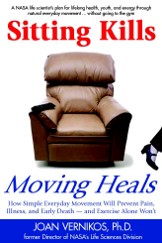
Just a quick shout out to point you towards this book, Sitting Kills, Moving Heals: How Simple Everyday Movement Will Prevent Pain, Illness, and Early Death -- and Exercise Alone Won't, Dr. Joan Vernikos.

There has been so much recently about the dangers of the sedentary life, but this book joins the dots in a very interesting way. Vernikos was involved in Space projets at NASA and she points out how the impact of weightlessness in space are actually the same impacts - but amplified and condensed - that flow from spending so much time sitting down.
Sitting is our way of avoiding the challenges, the exercise, that are properly delivered by gravity.
Her prescription is expected - move more - but it is the language that is interesting and motivating - the idea of doing more Gravity Exercises.
She points to some good research too. For example it is not just about spending time stood up....but the repeating acts of standing that are important. It reminds me of the floor exercises ideas that I pointed to a few weeks ago.
Highly recommended.
There has been so much recently about the dangers of the sedentary life, but this book joins the dots in a very interesting way. Vernikos was involved in Space projets at NASA and she points out how the impact of weightlessness in space are actually the same impacts - but amplified and condensed - that flow from spending so much time sitting down.
Sitting is our way of avoiding the challenges, the exercise, that are properly delivered by gravity.
Her prescription is expected - move more - but it is the language that is interesting and motivating - the idea of doing more Gravity Exercises.
She points to some good research too. For example it is not just about spending time stood up....but the repeating acts of standing that are important. It reminds me of the floor exercises ideas that I pointed to a few weeks ago.
Highly recommended.
Logical Fallacies and more thoughts on paleo

Consistency and habit
I am sorry that this blog has been quiet recently, but I've just not been finding things to post: either items that I wanted to highlight here or things that I wanted to write. I've been distracted by other things - like climbing hills in the sunshine and snow - but also I have been aware of the fact that sometimes there is not really much to say. In recent posts I've pointed to the idea that consistency and habit, patience and persistence trump most things when it comes to fitness and health. There is only so many times that you can say this before it gets boring.
Logical Fallacies
When I have been thinking about "fitness" issues I've actually been reflecting a lot on how limited my outlook has been for so long and how this might have been affecting my results. A lifetime ago - or so it seems - I did a degree in Philosophy. I did three years worth of formal logic, which was one of the parts of the course that I really enjoyed - the analysis, the equations into which arguments were broken down and expressed.
Recently I've been thinking about logical fallacies - errors in reasoning, arguments that might look valid at first but which on deeper consideration are actually invalid: the conclusion does not flow from the premises. There are lots of lists of such fallacies but Your Logical Fallacy Is... sets out a good few.
For example:
personal incredulity
Because you found something difficult to understand, or are unaware of how it works, you made out like it's probably not true.
or
the idea of an argument from silence: the absence of evidence is not the evidence or absence.....
Your exercise routine / diet is based on an invalid argument
Anyway, I suppose this gets me to some more thoughts on Paleo. The Paleo backlash is now underway with videos like this:
or Marlene Zuk's Paleofantasy (interviewed here)
I actually think the best analysis was done - with a good sense of humour - by Matt Stone in
12 Paleo Myths: Eat Better Than A Caveman
Reading that and thinking through the arguments a lot I came to realise that a lot of the dogma was just wrong. In terms of the logical fallacies we were so often at:
appeal to nature
You argued that because something is 'natural' it is therefore valid, justified, inevitable, good or ideal.
The whole grok thing, spinning an ideal of how we were intended to live.....it sounds good, it sounds romantic but either there is nothing to it or else it is just banal obvious statements.
Common Sense
I was trapped in a paradigm for a while there, seeing everything through the "primal" lens. Now I am realising that I was being stupid to be so limited in outlook.
Langganan:
Postingan (Atom)