cara agar cepat hamil weigh loss: Juli 2013

Minggu, 28 Juli 2013

Wall Sit research

James Steele was good enough to point this out to me.

In the basic Hillfit routine the wall sit is a fundamental exercise.  This is an isometric squat held for time with your back supported by a wall.  I included the wall sit for a few reasons:

  • you do not need any equipment
  • it is scaleable - if you are weaker, hold an easier position for example do not adopt a 90 degree knee position, don't bend your legs as far
  • it is low skill - you don't need to learn a complex move.  Squats are actually pretty complex to perform properly.  I think a good squat pattern is important for health and mobility.
  • it is safe - it keeps you in safe positions for your structure and muscles. (Bill DeSimone calls it a congruent movement - you use your muscles in a way that they are strongest where the movement is hardest)
I also find it an effective move for the thighs and hips in terms of producing strength.  Holding a 2 minute wall sit takes some strength.  I've talked about the exercise on this blog before by the way.

Anyway, James pointed out this paper, just published.


The isometric wall squat could be utilised in home-based training aimed at reducing resting blood pressure, but first its suitability must be established. The aim of this study was to determine a method of adjusting wall squat intensity and explore the cardiovascular responses. Twenty-three participants performed one 2 minute wall squat on 15 separate occasions. During the first ten visits, ten different knee joint angles were randomly completed from 135° to 90° in 5° increments; five random angles were repeated in subsequent visits. Heart rate and blood pressure (systolic, diastolic and mean arterial pressure) were measured. The heart rate and blood pressure parameters produced significant inverse relationships with joint angle (r at least –0.80; P < 0.05), demonstrating that wall squat intensity can be adjusted by manipulating knee joint angle. Furthermore, the wall squat elicited similar cardiovascular responses to other isometric exercise modes that have reduced resting blood pressure (135° heart rate: 76 ± 10 beats ∙ min−1; systolic: 134 ± 14 mmHg; diastolic: 76 ± 6 mmHg and 90° heart rate: 119 ± 20 beats ∙ min−1; systolic: 196 ± 18 mmHg; diastolic: 112 ± 13 mmHg). The wall squat may have a useful role to play in isometric training aimed at reducing resting blood pressure.


Interesting to see this benefit of the exercise - reducing blood pressure.  Exercise is often promoted as a way of controlling blood pressure, but people usually take that as "cardio", thinking strength training will raise blood pressure.  Here the wall sit is shown to be able to benefit blood pressure.

Another nice point in the abstract (I've not read the whole paper) is the observation that  

wall squat intensity can be adjusted by manipulating knee joint angle. 

That is what I mean by it being a scaleable move.


Senin, 22 Juli 2013

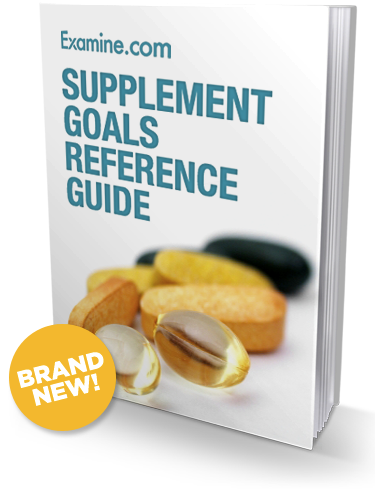
Examine's Supplement Goals Reference Guide

This post is a short interview with Sol Orwell.  Sol is the mastermind behind the amazing resource that is Examine.com  He has just launched a new product, a Supplement Goals Reference Guide, so I took the opportunity to ask him about Examine and the new Guide.

Can you tell my readers something about your background in health and fitness?

My journey is a bit different than most :) I "retired" a while ago - my internet businesses ran themselves, and I wasn't interested in the rat race. I'd rather travel, walk with my dog, and so forth. 
So after traveling and moving for a few years, I came back to Toronto in 2009. Out of shape (way too much delicious ice cream in NYC and Argentina). As I started fixing up my physical body, I also started reading and learning as much as I could. Im a notorious notes-taker, and slowly and surely the pieces started to come together.

What were you trying to achieve with the Examine.com website?

A lot of the knowledge I learned was from various forums. Forums always have their idiots, but some have some really smart people. People who have doctorates, people who compete, etc. And I noticed a lot of smart information was basically lost over time - we could have a really interesting conversation, but then one month later, that thread was (for all intents and purposes), gone. 
I wanted to build Examine.com as a repository of said information. I'll be honest - I knew a lot, but compared to some of these guys, I was a five year old. I found a great partner in Kurtis, who was just finishing up his dietetics degree. So he got to focus on the research, and I took care of everything else.
What does The Supplement-Goals Reference Guide add to the great information at Examine.com?
    The site is more geared towards the supplement->health goal relationship. It goes into pharmacology, interactions, etc. Basically, it's nerd heaven. I will eat a hat if anyone can find a page that goes more in-depth on supplements like fish oil, creatine, vitamin D, vitamin K, and so forth. 
    The reference is meant for two purposes: 
    1. Fast access. Open up the PDF, "search", and done. You instantly have the most pertinent info right in front of you - in vivo trials (animal and in-vitro studies excluded). 
    2. The opposite view: health goals->supplements. We are mostly anti-supplements in a bandaid fashion (eg if you eat fatty fish a few times a week, drop the fish oil). But targeted supplementation is brilliant. Berberine for diabetics. Spirulina for middle-aged people. Creatine for vegetarians. You can drill into your specific health goals (over 180), and find supplements that work (and even potentially supplements that can cause problems - eg someone with high blood pressure can find which supplements could increase his or her BP).

    Who is the Guide aimed at?
      People who take their health and fitness seriously. This includes coaches, naturopaths, teachers, nutritionists (all with clients), and also includes biohackers and quantified-selfers. People who appreciate their bodies and realize potential limitations (and potential areas to improve).

      Increasingly I have become disillusioned with a lot of the fitness information on the internet.  There are dodgy gurus out there promoting all sorts of secret knowledge to deliver muscle gain and fat loss.  Does the guide help to keep us on solid ground safe from the excesses of the marketing experts?
        You know it :-) We've been around for 2.5 years. We never recommend any brands nor any products. Our advisory board is not only chock full of pedantic people who take us to task for a misplaced word, but you can see on our testimonials that we have a host of MDs and PhDs who are willing to attach their name to what we do. And these are people from all over the fitness and health industry.
        The Guide
        Could the Guide save me money through stopping me buying useless pills?
          100%. Trib (for testosterone-boosting). Glutamine (for muscle building). Glucosamine for joint health? Black cohosh for monopausal symptoms? I could go on and on.

          Is there anything else you would want to tell the readers?

            We personally believe supplements are both over-rated and under-rated. As I broached before, one should not take supplements willy-nilly because it may have some undefined health benefits. Find out what your health goals, look up which supplements impact those goals (both positively and negatively), and supplement accordingly. Your health *and* your wallet will thank you.
            Thanks for that Sol!

            Examine.com is a superb resource which I would recommend to anyone with an interest in health and diet.  The Guide is adding something new and impressive to their toolkit.


            Senin, 15 Juli 2013

            A "does he even lift" jump

            What I like about this video is that the guy does not look like your typical uberlean fitness model.  He is an O lifter and a great athlete however.

            Rabu, 10 Juli 2013

            Searching for validation

            No magic bullet

            One of the themes that I've come back to a few times in recent months is the fundamental that there is no "magic bullet" when it comes to training.  So often we are searching for the new method, the gnostic truth that, after all these years, will finally yield those long desired gains in muscle and losses of fat.  We are a desperate and gullible market.  Show us an abstract from a study, or an impressive transformation photo and we are yours...paypal dollars flow for whatever ebook or course you are selling.

            The truth of course is that there is no secret method.  Patience, consistency and simplicity are what counts.  Realistic expectations.  The fundamentals remain fundamental.  Train hard, progressively and consistently over a protracted period on some safe exercises and be satisfied with the results.  Lots of methods will work within that space.

            Tell me I am OK

            What I've noticed in myself a few times in relation to all this is how eagerly I seek validation of my ideas.  I will mull over my training, analyse and re-analyse an exercise or routine and come up with an approach that I think will work for me.  Then, however, I start to google.....I begin to try to find those out there that agree with my approach, my new idea.  If I find some to agree with me - then great.  If not then I am cast into a slough of despond and doubt.

            The basics

            Let's just be boring.  Stick to some basics for a while.  Forget what else is out there.  Put some blinkers on for a while.  Give it a chance.  Be realistic.  Stick at it long enough for it to make a difference.


            Selasa, 09 Juli 2013

            Seated Box Jump

            I haven't had a decent jump on here for a while

            Resistance training is not rocket science; simple is almost always best

            The title of this post is a simple quote straight from an article by Clarence Bass.  He is someone that I have referred to on this blog before, someone who has long been an inspiration and an education, since I first read his book Ripped in 1986.    He has informed my thoughts about training and diet as much as anyone has.

            This article says a lot about what i think about training.